 The prosecution and defence consider the trial one of constitutional significance. Yet it was not on the court docket, the registry would not advise which of Auckland’s 16 district courtrooms it was being held and the defendant was told by police days before trial it would be closed to the public.
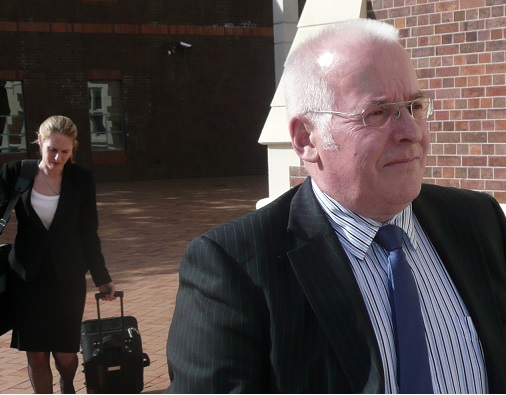
A 54 year-old Auckland father stands accused of threatening and intimidating a judge 25 February, then assaulting another judge 1 March 2018 when the two passed on the Federal Street footpath. The defendant was prior known to both judges and had protested in front of the home of one.
Two legal aid lawyers cited conflicts of interest in declining to represent the defendant. A third quickly fell away when the defendant said he would seek to have the suppression orders lifted.
The case highlights a self-imposed crisis in New Zealand today, pitting rights of free speech and assembly against the rights of judges to conduct their State business in secret and without fear of public criticism. Former Attorney-General Chris Finlayson - an unelected member of Parliament who appointed 80% of the nation’s current judges during his 9-year tenure as Attorney-General - tried for years to push through legislation that would criminalise criticism of and ‘making untrue allegations’ about judges. Earlier this year his push gained momentum after current Minister of Justice Andrew Little suggested the Labour government may adopt Finlayson’s proposed member’s bill. Little later called peaceful protests outside three family court judges’ homes “very disturbing” and said there was no excuse for people taking their case to the front door of a judge
Apart from the people’s law passed by Parliament New Zealand judges have in the past three years granted themselves broad extra-legislative powers to suppress public court information. This includes affirming inherent powers to issue and criminally enforce non-publication orders binding on the world in Erceg v Erceg [2016] (the Supreme Court of NZ conceding at [7] New Zealand is an “outlier” among democracies in bestowing such broad judicial powers) and the power to override legislation which affords public access to court records in Greer v Smith [2015]. The Smith ruling is an ex parte ruling by the full bench of the Supreme Court which declared any one of their members can issue a minute to prevent public access to court files and that such “administrative” directions are “not appealable”.
The secrecy in the current criminal trial is consistent. Court staff claimed the trial was covered by suppression orders which prevented them from divulging information that included the courtroom number. The judge alone trial was heard in courtroom 6, the hardest to get to. The courtroom was cleared by Police mid-hearing on Friday and a friend of the defendant arrested for alleged breach of the Search and Surveillance Act 2012 after he took a photo of one of the judge witnesses. He was fined $1,000 and told by police not to protest in front of judges’ homes. The Auckland residing defendant has as his bail condition a prohibition against travelling north of the Harbour Bridge.
It is left to presiding Judge Peter Rollo whose wife is also a District Court judge to sort out the issues and determine guilt or innocence. Judge Rollo overruled procedural objections by the prosecution repeatedly during the trial, saying he was giving the self-represented defendant leeway in his cross-examination of witnesses in order to ensure a fair trial and to avoid appeal.
The first witness judge consequently spent a half day in the dock; in the end providing a consistent and believable short sequence narrative of how he was suddenly encountered by the defendant on a CBD street, chastised for issuing a judgment deemed unfair to the defendant’s son and loudly called - depending upon which version Judge Rollo adopts - a “child abuser” or “pedophile”. The witness said he felt threatened when the defendant announced “They will be coming to your house next.”
The second witness judge was a contrast. This witness admitted being prior advised by his judicial colleague of his confrontation. He testified the defendant had previously defamed him and that he doubted the lawfulness of an earlier peaceful protest attended by the defendant in front of his own home. A week following his colleague’s encounter he just happened to be walking up the same street at the same time (the defendant providing evidence he always walked this route home at 5pm). The witness testified he and the defendant saw each other from 20 metres away and that “we walked with purpose” toward the other. When they were two metres apart he alleged the defendant spat on him, squarely hitting him in the front right thigh. The witness stated he then held up his briefcase to prevent what he thought would be a personal assault but the defendant walked passed him, only to turn back and push the witness “two or three times” with both hands into the street and road works where he almost lost his balance. The witness said the force was a 7 or 8 on a scale of 1-10.
On cross-examination the witness was asked if he pushed the defendant with his briefcase when passing. The witness responded by asking whether that would be the defendant’s evidence; to which he was reminded by the defendant examiner it was not his to ask the questions. The witness then added he had his trousers up in his chambers which he preserved with the spit on them.
The defendant’s testimony was he did not spit on the witness. He pointed out his DNA was taken by police when he was arrested and there was no evidence given that his DNA matched the trousers. The police then admitted they never tested or knew of the evidence and asked Judge Rollo to put it to the defendant he risked perjury if a subsequent DNA test proved positive. When the defendant confirmed he wanted the trousers tested presiding Judge Rollo drew upon his 16 years of judicial experience handling mostly criminal cases to suggest any DNA on the trousers might be too degraded to test considering the event occurred over two months ago.
With all witness evidence concluded, the trial was adjourned until August to allow Police to confer with the second witness as to whether DNA testing will be done on his trousers. If convicted the defendant faces up to two years in prison.